
How to Innovate, Even in Crises
© E D Deane, 2026. You may use or distribute this document under the following conditions:
- Credit must be given to the creator and logos may not be removed.
- No derivatives or adaptations of the work are permitted.
HOW TO INOVATE FOR GROWTH, EVEN IN CRISES.
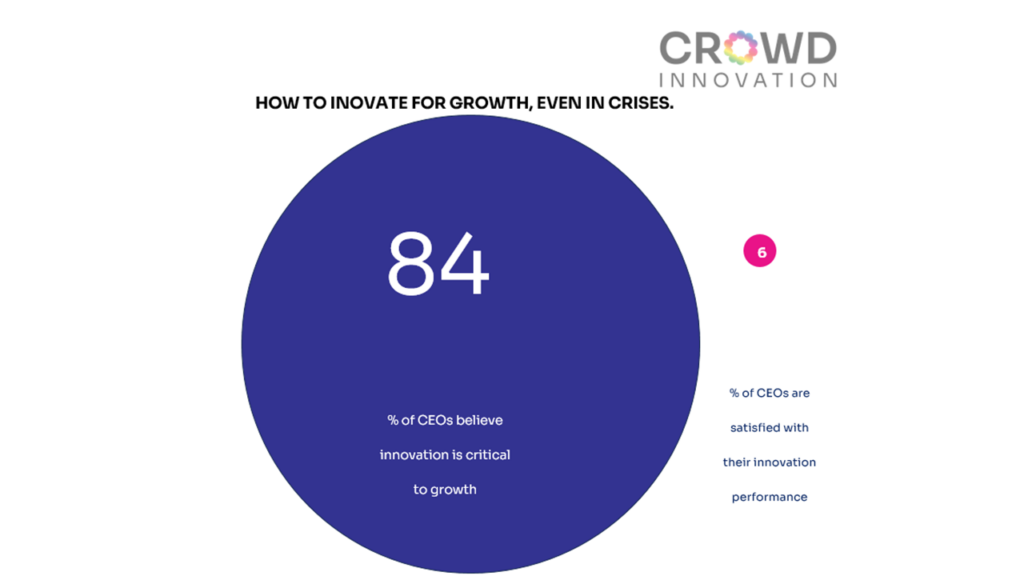
The two proportionate (and graphically accurate) dots on our front page tell the story between the perceived value of innovation by CEOs and the CEOs perception of the company success in making innovation successful. In our last Insights article, we focused on why companies should innovate, this time the insights are about how to do it. We highlight priority tools used to achieve your desired results. With Africa Countries forecast to have high growth rates in 2026, even in the prevailing uncertainty, it’s critical that our innovations serve the long term, sustainable objectives, of our continent, our businesses and our people. The 2025 McKinsey research shows using multiple paths to growth is critical. With all these factors it is sometimes difficult to remember to focus on practical steps. This Insights Article aims to highlight practical tools that make a big difference. Download our free 1 slide for team discussions. (inset link)
Innovation has become a specialised business discipline, and the tools available are constantly evolving. The practices below come from recent McKinsey innovation research, that applies to almost all industries, they reflect the methods used by those companies that achieve both high degrees of innovation and high growth. Without a doubt, the top performing companies use all the methods, and build an ecosystem of innovation practices. We anticipate that they will continue to incorporate new methods as they emerge.
Established Methods
Innovation Process
Formalising innovation by adopting a formal process shows improved speed of up to 75%. This is critical because companies currently report that 25% -30% of innovations are either delivered late, or over budget, or both. This applies to both incremental innovations as well as large scale innovation. Formal innovation processes are also linked to talent retention and an organisational capability to scale new business and new products. A formalised approach also allows a view of long term and short-term projects, allowing companies to find the balance.
Research adn Development (r & D)
As part of research and development activities, many top performers use patents as a measure of success. Top performers produced more than 100 patents than similar companies. The patents were frequently linked to other patents they hold in a particular discipline, making it difficult for others to copy, or innovate close to a patent.
Resources
Appropriate resources (funding, people, technology etc) is strongly linked to increased revenue, and growth as a result of innovation. Innovation is so important to top performing companies that they are willing to increase innovation spend, even in difficult economic times. Even more emphasis on innovation was placed by CEOs that believe that their company will not innovate; similarly for those CEOs who thought that the company may not remain financially viable without innovation efforts. Resources are considered an investment in the company’s future and innovation success metrics reflect this.
Operational Agility
nnovation is best supported by an agile operating model, a culture that supports innovation and a bigger investment in digital and analytics than competitor organisations. “Digital” includes generative AI.
Merger and Acquisition CApability
Strategic alliances, including mergers and acquisitions, are a good way to enhance company intellectual property, access to talent, and acquire new capability. Critical success factors include having clear objectives for the type of organisations sought, what the M&A Programme is expected to deliver, and clear processes that allow quick movement through the process. This approach not only benefits performance, but also controls risks. This method is particularly common when expanding technology IP.
Emerging Method: Crowdsourcing
When comparing Crowd Innovation’s research into crowdsourcing with some of the McKinsey tools listed above it is clear that crowdsourcing can make a meaningful contribution to each category:
Category
Available with Crowdsourcing
Notes
Innovation Process

- In our crowdsourcing process, we adhere to research-based processes which dovetail with organisational innovation processes.
- Used correctly, crowdsourcing can extend the company’s innovation capability cost effectively.
Research and Development
- Research and development projects are structured as contests and placed with an external crowd for faster, less risky and often less costly solutions than conventional R & D activities.
- There are mechanisms for keeping work confidential, even though projects are placed with external crowds.
Resources
- Crowdsourcing can extend client innovation reach: Crowds are curated according to the needs of the project. There is no long-term financial commitment for additional resources.
- Our Founder and CEO has direct oversight over every project.
Operarional Agility
|
Merger and Acquisition Capability
- Crowdsourcing is an excellent method for sourcing potential strategic alliances, including M & A activity.
Crowdsourcing is an emerging technology when it comes to company innovation, but the idea has been around for several hundreds of years. In our research, we found that crowdsourcing isn’t discussed often by business, but it is the underlying principle for applications as diverse as Bookings and Google Maps; it can therefore be easy to miss. Interestingly those using it for business innovation usually chose to partner with external specialists, rather than build internal capability. The method is flexible and is most often used because it is considered quicker, less expensive and less risky than other methods. Another benefit of using this method is that it allows access to and comparison of international as well a local service providers until the optimal solution is found. This makes it ideal for African and South African conditions. We offer services tailored to make each project work. It is also what makes it possible to innovate even when in crises. Our research showed that not only did crowdsourcing make innovation possible within struggling organisations, but that struggling organisations relied on crowdsourcing as part of their turnaround strategy.
Crowdsourcing is also what makes it possible for companies to innovate, even when in crises. Our international research shows that not only does crowdsourcing make innovation possible within struggling organisations, but that struggling organisations relied on crowdsourcing as part of their turnaround strategy. This because it is lower cost than other methods, the company pays the fees for searching, but there is no fee if the ideal solutions is not found. This similtaneously reduces risk. Also, struggling companies need to find solutions quickly, and crowdsourcing offers innovation at speed. By using crises as a catalyst for lasting, innovative change, crowdsourcing can serve as an effective vehicle.
Let us know on our LinkedIn page which method(s) you use, and why.
Our free, 1 page, downloadable, summary slide can be accessed below.
Crowd Innovation holds regular introductory talks that includes case studies. Apply to attend a session here. During this talk we provide a link where you can book a free, thirty- minute discussion to discuss your organisation’s needs. We look forward to meeting you.
Sources
Tip: If using this article academically, go back to the originals below. Some are in academic journals, use Google Scholar to find them.
https://africarenewal.un.org/en/magazine/african-economies-grow-2026-despite-uncertain-global-context?_gl=1*2vffp4*_ga*NTU2NDkzNjM4LjE3NzQ0MzA5ODA.*_ga_TK9BQL5X7Z*czE3NzQ0MzA5ODEkbzEkZzEkdDE3NzQ0MzEwMDgkajMzJGwwJGgw
Human Disclaimer
Our research and insights articles are written by humans. A such you may find occasional grammatical or spelling errors, that we ask you to forgive in favour of human qualities like care for people, courage, accuracy and human relationships. Our facts are checked and we are not prone to hallucination.